
STARSET has never been a band that simply releases music.
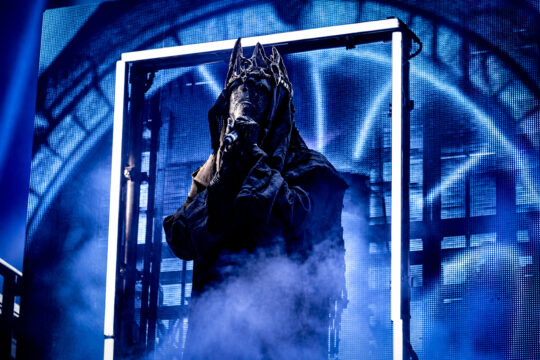
From the mythology of the STARSET Society to transmissions, technological warnings, dystopian imagery and interconnected narratives, the band has spent years encouraging listeners to look beneath the surface. With STARSET’s latest run of singles, there may now be something hiding in plain sight — specifically, within the song titles themselves.
The three titles are stylized as:
parad0x1c
ann1h1lat10n
transfus10n
At first glance, replacing letters with numbers fits perfectly with STARSET’s technological aesthetic. Look closer, though, and there is a remarkably consistent pattern.
Every numerical substitution is either a 0 or 1.
And they aren’t being placed randomly.

From I/O to 1/0
The titles appear to systematically replace the letters I and O with their binary-looking counterparts, 1 and 0.
parad0x1c contains:
01
ann1h1lat10n contains:
1110
transfus10n contains:
10
That alone is interesting because I/O — input/output — is fundamental computer terminology. Visually converting I/O into 1/0 effectively transforms letters associated with computing into the two digits upon which binary computing is built.
But that’s where the rabbit hole really begins.
Could the Numbers Reveal the Track Listing?
If each sequence is interpreted individually as a binary number, something interesting happens.
01 in binary equals 1.
10 in binary equals 2.
1110 in binary equals 14.
That would potentially give us:
Track 1: parad0x1c
Track 2: transfus10n
Track 14: ann1h1lat10n
If intentional, that would also suggest the eventual album contains at least 14 tracks.
It’s a remarkably clean result, particularly with 01 and 10 translating directly into tracks one and two.
There is, however, another way to read the code.
And this one might be even more interesting.
01111010
Instead of treating the numbers within each title independently, arrange them according to the singles’ release sequence:
01 + 1110 + 10
Put them together and we get:
01111010
That’s eight binary digits.
In computing, eight bits make one byte.
And when 01111010 is interpreted as an eight-bit ASCII character, its decimal value is 122.
ASCII 122 represents:
z
So the first three titles, taken together, potentially encode a lowercase “z.”
Is that actually STARSET’s intention?
We don’t know.
One completed eight-bit sequence isn’t enough evidence to establish a pattern. It could be coincidence, particularly because the binary digits originate naturally from replacing I’s and O’s within otherwise recognizable words.
But the fact that three consecutive titles happen to produce exactly eight bits makes the possibility worth watching.
If the next STARSET titles continue using the same naming convention, the theory becomes testable.
Suppose the next few titles generate another eight digits:
????????
Those eight bits could then be translated into another ASCII character.
If they produce a recognizable letter, and subsequent titles continue producing eight-bit ASCII characters, STARSET may effectively be revealing a hidden message one byte at a time.
For now, our first hypothetical character is:
01111010 = z

There’s Another Clue Hidden in parad0x1c
There may even be a second layer to the first title.
Look carefully at the ending:
parad0x1c
Specifically:
0x1C
In programming, the prefix 0x is commonly used to indicate a hexadecimal number.
That means 0x1C isn’t merely something that looks like computer code. It’s valid hexadecimal notation.
0x1C equals 28 in decimal.
That raises another possibility: perhaps STARSET isn’t asking listeners to read these substitutions exclusively as binary. The hexadecimal-looking construction could be another piece of the puzzle, a key for decoding something later, or simply another deliberate nod toward computer language.
At this point, there isn’t enough information to determine which interpretation — if any — is correct.
Three Singles. Three Possibilities.
For now, the numerical titles leave us with three particularly interesting possibilities.
The numbers could represent binary track positions, potentially placing the songs at tracks 1, 2 and 14.
They could form a continuous binary message, with the first three singles producing the eight-bit ASCII character “z.”
Or the binary and hexadecimal references could be components of a larger cipher or puzzle that won’t become apparent until STARSET reveals more of the project.
There is always the fourth possibility, of course:
We’re looking far too deeply into some creatively stylized song titles.
But this is STARSET.
Looking too deeply into things is half the fun.
For now, I’m keeping one string written down:
01111010
And one letter beside it:
z
When the next transmission arrives, we’ll see whether STARSET gives us another piece of the code.
[END TRANSMISSION]