October 9, 2026
The Truman, Kansas City, Missouri
Words and Photos by Adam Tibbott
There was something familiar about the aggression inside Kansas City’s The Truman on Friday night. Something I hadn’t experienced on this level in a few decades. It wasn’t simply the volume of the music, the brutality of the breakdowns, the wall of death, or the bodies colliding in the circle pits. It was the intensity behind it all. The kind of collective frustration that transforms a concert from an evening of entertainment into something far more primal.
For someone who has spent more than 25 years photographing live music, it felt like witnessing the return of an energy that had been largely absent from the concert scene for over a decade.
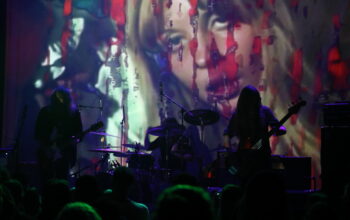
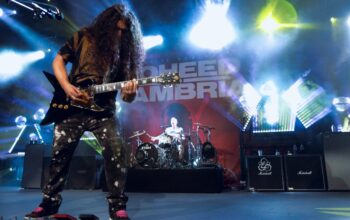
Swedish metalcore heavyweights thrown brought their headlining tour to Kansas City with an exceptionally diverse supporting lineup featuring Norma Jean, Half Me, and BOLTCUTTER. Four bands representing different generations and interpretations of hardcore and metal, each delivering its own distinct brand of aggression.
It was my first time attending a concert at The Truman and, remarkably, my first time seeing all four bands perform live. I had been particularly excited about Half Me and thrown, but there was also some unfinished business with Norma Jean, a band that had occupied a place on my concert bucket list for decades.
By the end of the evening, every expectation had been exceeded.
The Truman: An Industrial Setting for an Unrestrained Crowd
Located in Kansas City’s Crossroads Arts District, The Truman occupies a repurposed industrial building with exposed brick, steel beams, and an expansive open floor. The venue’s approximately 1,200-person capacity creates an environment that feels substantial without sacrificing the intimacy that makes smaller concerts so memorable. For a lineup this aggressive, the setting felt appropriate.
The audience was an interesting cross-section of generations, ranging from elder millennials who had grown up with the chaotic metalcore explosion of the early 2000s to Gen Z fans embracing the genre’s increasingly brutal modern evolution. It was a reminder that heavy music doesn’t belong exclusively to any particular generation.
And judging by the increasingly violent movement across the floor, neither does the desire to release a little pent-up frustration.
Half Me: Calculated Aggression, Anger With a Purpose
Of the four bands performing, Germany’s Half Me was one I had been particularly eager to experience.
Their music occupies an interesting space within contemporary modern metalcore, incorporating elements of nu-metal, hardcore, and industrial-influenced heaviness into something that feels both familiar and distinctly modern. But what stood out most about their performance was the precision of their aggression. Half Me wasn’t simply angry. Their anger had a purpose.
There was a calculated quality to their performance, as though every punishing breakdown, rhythmic transition, and explosive vocal delivery had been carefully positioned to maximize its impact.
Their set drew from their debut album, SOMA, alongside material representing the band’s next chapter. Songs from the evening’s Crusade included “King,” “Built On Your Blood,” “Splinter in a Rusted Crown,” and “Dogma.”
The contrast between their established material and newer releases demonstrated a band continuing to refine its identity without sacrificing the hostility that makes its music so compelling. What impressed me was how controlled everything felt, even when the music itself sounded as though it was threatening to collapse into complete chaos.
There is a difference between making aggressive music and understanding how to weaponize that aggression in a live setting.
Half Me clearly understands that distinction.
BOLTCUTTER: Spontaneous Chaos and Unfiltered Rage
Where Half Me approached aggression with precision, BOLTCUTTER seemed determined to dismantle any remaining sense of order.
The Oregon hardcore outfit brought an entirely different kind of hostility to The Truman.
Their performance was intense, chaotic, and almost spontaneous in its delivery. Where Half Me’s aggression felt carefully constructed, BOLTCUTTER’s seemed to erupt without warning.
Their music draws heavily from beatdown hardcore and slam-influenced metal, emphasizing punishing rhythmic patterns and the kind of breakdowns seemingly designed to provoke an immediate physical response. And the crowd was more than willing to oblige.
The band’s ten-song set included “Peterbilt Homicide,” “Pocket Check,” “Richless & Bitchless,” “Shotgun Suckstart,” “Ballpeen Bludgeoning,” and “Twenty One Cars,” before concluding with “Still Broke.”
Perhaps most interestingly, three songs were on the printed setlist as “new track,” with two appearing at the very beginning of the performance. It takes a certain amount of confidence to introduce unfamiliar material so early in a set, particularly when performing for an audience that may be discovering your music for the first time.
But BOLTCUTTER’s appeal isn’t dependent on familiarity. Their music is immediate, confrontational, and physically demanding.
There was nothing particularly subtle about their performance, nor did there need to be. Sometimes chaos is the entire point.
Norma Jean: Decades of Anticipation and a White-Knuckle Stranglehold
Norma Jean was different, though. For me, this performance carried a significance that extended well beyond the music itself.
I’ve been following the band’s career for decades, but somehow, through an almost comical succession of scheduling conflicts, personal obligations, and unexpected life events, I’d never managed to see them perform. Every opportunity seemed to slip away.
Finally standing in front of Norma Jean at The Truman felt like closing a chapter that had remained unfinished for far too long.
And they made the wait worthwhile.
Unlike BOLTCUTTER’s spontaneous hostility or Half Me’s precisely engineered aggression, Norma Jean approached their performance with an almost theatrical understanding of tension.
They allowed that tension to build. They gave the audience time to anticipate what was coming. And then they unleashed an absolutely calculated display of brutality.
Once they established their grip on the room, they maintained a white-knuckle stranglehold on the audience for the remainder of their performance. Norma Jean has spent nearly three decades helping shape the evolution of metalcore, particularly its more chaotic, experimental, and rhythmically unpredictable elements.
Their eleven-song setlist reflected that history, drawing from multiple periods of the band’s career.
Opening with “1994,” the band moved through “Mind Over Mind,” “Spearmint Revolt,” “Blueprints for Future Homes,” and “Trace Levels of Dystopia,” before revisiting other chapters of their catalog with “I. The Planet,” “1,000,000 Watts,” and “Bayonetwork: Vultures in Vivid Color.”
The final stretch included “I Used to Hate Cell Phones but Now I Hate Car Accidents” and “If You Got It at Five, You Got It at Fifty,” before closing with the monumental “Memphis Will Be Laid to Waste.”
That final song felt particularly appropriate. For longtime fans, it represents an important piece of metalcore history. For newer listeners, it provides a glimpse into the chaotic foundations upon which so much contemporary heavy music has been built.
Watching Norma Jean perform alongside bands whose careers emerged decades later was a fascinating reminder of just how much the genre has evolved.
But perhaps more importantly, it demonstrated how much of its original intensity remains intact. Some bands grow older and soften their approach. Norma Jean has apparently never received that memo.
thrown: Immediate, Unapologetic Savagery
By the time thrown took the stage, the audience had already endured three increasingly punishing performances.
There was no opportunity to recover. There was no gradual introduction. There was no easing into the headliner’s set.
thrown arrived with unadulterated savagery, and they made absolutely no apologies for it.
The Swedish quartet has developed a reputation for condensing extraordinary amounts of aggression into relatively short compositions, combining modern metalcore, nu-metal influences, and beatdown-inspired grooves into a sound that rarely allows listeners to catch their breath.
That approach translated into an overwhelming live experience.
Opening with “grayout,” thrown immediately established the tone for the remainder of the evening. “Guilt,” “parasite,” “rehearsed,” and “split” followed, creating an opening sequence that offered little opportunity for the crowd to regain its composure. Their fifteen-song performance continued through “fast forward,” “ignored,” “new low,” and “on the verge,” before moving into “critic” and “unwanted.”
The latter offered a preview of the band’s forthcoming sophomore album, UNWANTED, scheduled for release in November.
The closing stretch of “bloodsucker,” “vent,” “look at me,” and “nights” maintained the intensity established from the opening moments.
What makes thrown particularly effective is their refusal to waste time. Their compositions are compact, their breakdowns arrive with devastating efficiency, and their live performance embraces that same philosophy.
There is very little unnecessary decoration.
Everything exists to serve the impact of the music.
And inside The Truman, that impact was impossible to ignore.
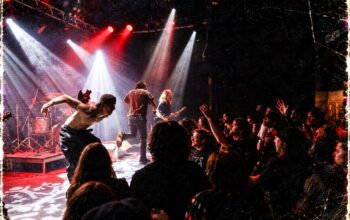
The circle pits that had been growing throughout the evening finally reached their peak during thrown’s performance. What began as an increasingly energetic audience response had evolved into something considerably more ferocious.
There was no mistaking which band had the final word.
The Return of the Pit: A Different Kind of Catharsis
As impressive as the individual performances were, one of the most memorable aspects of the evening wasn’t happening onstage.
It was happening in the crowd.
I’ve photographed thousands of concerts over the past quarter-century, and I’ve witnessed just about every variation of audience behavior imaginable. The aggression inside The Truman reminded me of something I hadn’t experienced on this scale in a very long time. It reminded me of the early 2000s.
Specifically, the years immediately following September 11, 2001, when the emotional atmosphere surrounding heavy music seemed particularly volatile.
There was an unmistakable sense of frustration in many of those audiences. Anger, uncertainty, and anxiety often appeared to find their release through the physicality of hardcore and metal concerts.
I’m not suggesting that the circumstances surrounding 2026 are identical to those of 2001, or that every person in Friday night’s audience was motivated by the same frustrations. But the emotional intensity felt remarkably familiar.
There seemed to be an underlying urgency to the movement inside those circle pits, as though people were using the music to work through frustrations that extended beyond the walls of the venue.
And I couldn’t help thinking about how much concert audiences have changed since the COVID-19 pandemic.
In the years immediately following the shutdowns, I noticed something different about mosh pits. They often seemed subdued.
Audiences appeared more hesitant to crowd together, almost as though the prolonged period of social distancing had left behind an instinctive reluctance toward physical proximity.
The pits were still there, of course.
But something about their intensity felt diminished.
Friday night at The Truman was the opposite.
There was no hesitation.
The circle pits grew increasingly aggressive with each passing band, eventually reaching a level of ferocity during thrown’s performance that reminded me of the concerts I photographed more than twenty years ago.
What made it especially fascinating was the generational makeup of the audience. Elder millennials and Gen Z fans were sharing the same floor, participating in a form of musical expression that has endured through decades of cultural changes.
The styles of music have evolved. The bands have changed. The generations occupying the concert floor are different.
But the underlying need for release remains remarkably consistent. Sometimes people don’t want to quietly process their frustrations. Sometimes they want to scream, collide, sweat, and disappear into the collective energy of a room filled with people who understand exactly why they’re there.
For a few hours, that shared experience becomes its own form of catharsis.
And on Friday night, The Truman provided plenty of it.
Four Bands, Four Interpretations of Aggression
Looking back on the evening, what impressed me most was how naturally these four bands complemented one another despite their stylistic differences.
Half Me delivered calculated aggression, anger shaped into something deliberate and purposeful.
BOLTCUTTER countered with spontaneous chaos, unpredictable hostility, and an almost reckless sense of urgency.
Norma Jean demonstrated the power of tension and restraint, building anticipation before releasing carefully controlled brutality upon an audience that had no intention of escaping.
And thrown eliminated the anticipation altogether, delivering an immediate, relentless assault that refused to lose momentum.
Each band represented a different chapter, and interpretation of heavy music’s relationship with aggression. Yet rather than competing against one another, those differences created a remarkably cohesive evening.
There was something almost poetic about watching Norma Jean, a band whose influence reaches back to the formative years of modern metalcore, sharing a stage with newer acts carrying that aggression into another generation.
It was equally rewarding to experience a venue I’d never visited before and finally cross four bands off my ever-growing list of artists I’ve wanted to photograph. Norma Jean, in particular, had been a long time coming. After more than two decades of missed opportunities, finally seeing them perform was worth every year of anticipation.
But perhaps the biggest takeaway from Friday night’s concert was the realization that the raw emotional intensity I remember from the early days of my concert photography career hasn’t disappeared.
It has simply evolved.
New bands have emerged. New generations have discovered the music. New frustrations have found their way into the lyrics, the breakdowns, and the movement of the crowd.
And when the right combination of bands, audience, and atmosphere comes together, that familiar aggression returns with astonishing force.
On October 9, 2026, inside The Truman in Kansas City, four bands reminded me why I fell in love with documenting live music in the first place.
The music was different. The generations were different. But the release felt exactly as powerful as I remembered.