Anders Colsefni and The Crowz, Reaping Asmodeia, Ben’s Raincoat, and Yanderu
October 16, 2026
The Waiting Room Lounge, Omaha, Nebraska
Words and photos by Adam Tibbott
There are nights when you walk into a concert knowing exactly what to expect, and there are nights when the music reminds you why you’ve spent so many years standing in front of stages, watching bands pour everything they have into their performances.
Friday night at Omaha’s Waiting Room Lounge offered a little of both. The evening brought together four bands representing different corners of extreme metal, from Omaha’s emerging underground talent to seasoned touring musicians and a vocalist whose place in Iowa metal history stretches back more than three decades. Headlined by Anders Colsefni and The Crowz, the concert was as much a celebration of musical history as it was a showcase of what the next generation of heavy music has to offer.
And somewhere between the opening band’s first notes and the final moments of the headlining set, the evening became a reminder that great music doesn’t have an expiration date.
Yanderu: Familiar Faces, Different Aggression
Omaha’s Yanderu opened the evening with a solid, aggressive sound that immediately established the night’s atmosphere.
For those familiar with the local metal scene, there were some recognizable musicians onstage. Yanderu’s drummer also serves as the vocalist for Sight Rot, while the band’s guitarist shares guitar duties with that same Omaha outfit.
It’s always interesting watching musicians explore different creative directions outside their primary projects, and Yanderu demonstrated that these musicians have plenty to offer. What stood out most was the vocalist’s range. Death Metal isn’t necessarily a genre associated with broad vocal versatility, at least not to listeners unfamiliar with its many variations, but Yanderu’s frontman demonstrated an impressive ability to move through the demands of the band’s material.
Their sound was solid, their performance confident, and they provided a fitting introduction to an evening that would only become more intense.
Ben’s Raincoat: A Local Band With National Potential
I’ll admit something that might surprise people who have followed my concert photography and reviews over the years: death metal has never been one of my favorite genres.
I appreciate the musicianship, technical abilities, and dedication required to perform it, but it isn’t necessarily what I reach for when choosing something to listen to. Every so often, however, a band comes along that makes those preferences irrelevant. Friday night, that band was Ben’s Raincoat.
The Omaha-based progressive death metal outfit delivered an absolutely phenomenal performance, combining technical precision with an intensity that felt considerably larger than the room they were playing. After spending more than two decades photographing bands at every level, from tiny clubs to massive arenas, I’ve developed a sense for recognizing when a local band has what I call those “national touring band vibes.”
It’s difficult to explain precisely what creates that impression. Sometimes it’s the musicianship. Sometimes it’s stage presence. Other times it’s the chemistry between musicians who seem to instinctively understand exactly what everyone else onstage is doing. And sometimes, everything simply comes together. Ben’s Raincoat gave me that feeling. In fact, I would go so far as to say that this is a band with the potential to eventually operate on the same level as acts like Lorna Shore. That’s not to suggest they’re already there, or that their music is identical. Rather, it’s a reflection of the level of talent and promise I witnessed Friday night.
Local bands deserve the same attention and respect afforded to national touring acts. Being local describes a band’s current reach, not the limits of its abilities. If Ben’s Raincoat continues developing at this level, I wouldn’t be surprised to see their name appearing on much larger bills in the future.
Reaping Asmodeia: Precision Beneath the Aggression
Minnesota’s Reaping Asmodeia brought a different kind of intensity to The Waiting Room. Where Ben’s Raincoat impressed me with their potential, Reaping Asmodeia demonstrated the confidence of musicians who are already deeply attuned to their craft.
Their performance leaned into the more melodic aspects of technical death metal, balancing punishing aggression with arrangements that allowed the individual musicianship to shine. Songs including “False Awakening” and “Simulacra” provided glimpses into a sound that was both uncompromisingly heavy and surprisingly intricate.
There was nothing particularly frantic about the way Reaping Asmodeia commanded the stage, despite the intensity of their music. Their movements and interactions reflected the confidence of performers who understand their material and know exactly how to deliver it.
The result was an impressive display of musical discipline wrapped in the controlled brutality of extreme metal. By the time their set concluded, the evening had already delivered three strong performances, each with a distinct musical identity.
But the night’s final act carried something the others couldn’t: Thirty years of history.
Anders Colsefni and The Crowz: Piercing the Umbra
To fully appreciate what Anders Colsefni and The Crowz brought to The Waiting Room, it’s worth understanding a piece of Slipknot history that often gets overshadowed by everything that came afterward. Before the masks became instantly recognizable, before the platinum albums and massive international tours, Slipknot was an experimental group of musicians in Des Moines, Iowa, exploring sounds that didn’t fit comfortably into any established genre.
Their independently released 1996 recording, Mate. Feed. Kill. Repeat., was a strange and fascinating combination of death metal, funk, jazz, groove, and experimental arrangements. And much of its early lyrical mythology drew inspiration from Werewolf: The Apocalypse, the tabletop role-playing game that Anders Colsefni and Shawn Crahan had explored.
Within that game’s mythology, the Veil separates ordinary human awareness from the supernatural world, while the Umbra exists as a spiritual reality alongside our own. Rage is more than an emotion; it’s a powerful, primal force that can either empower or overwhelm those who possess it.
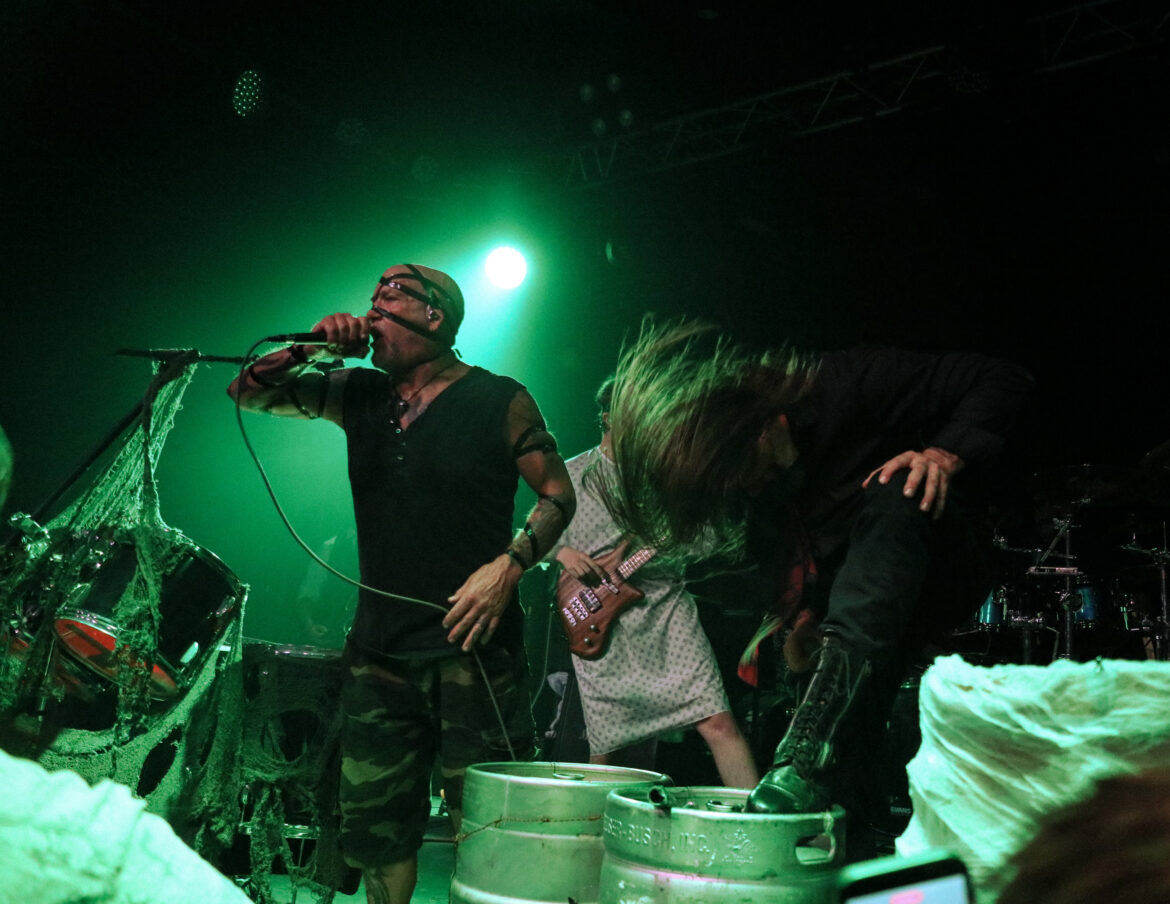
Friday night’s performance felt like lifting that Veil and piercing the Umbra. For a little over an hour, the distance between 1996 and 2026 seemed to disappear, revealing a version of Slipknot’s musical history that existed long before the rest of the world discovered the band. This wasn’t simply about hearing old songs again. It was about experiencing those compositions in something closer to their original, primal forms.
I last saw Anders Colsefni and The Crowz on June 6, when the project was still finding its footing onstage. That performance was fueled by reckless abandon. It was raw, unpredictable, and overflowing with the kind of unrestrained aggression that characterized Slipknot’s earliest years. Four months later, something had changed. The aggression hadn’t disappeared. If anything, it had become more focused.
Friday night’s performance was controlled chaos, an orchestrated assault of finely tuned aggression that felt considerably more deliberate and rehearsed. Even with several changes to the lineup, including a replacement guitarist, The Crowz sounded tighter and more comfortable with the material.
The anger was still there, but this time every moment of it seemed to have a purpose. It was almost as though the Rage that had been unleashed in June had finally learned how to control itself. And that evolution made the performance all the more compelling.
Thirty Years of Slipknot History, Twelve Songs at a Time
Following an the MFKR intro, The Crowz launched into “Slipknot,” immediately establishing the evening’s connection to the band’s earliest material. “Gently” followed, its ominous atmosphere serving as a reminder of how far back some of Slipknot’s most recognizable compositions actually stretch.
“Do Nothing/Bitchslap” and “Windows” continued the exploration of the band’s experimental roots, before “Tattered & Torn” brought another familiar title into the performance. What makes these songs particularly fascinating is how differently they can feel when approached through the musical identity that existed before Slipknot’s 1999 breakthrough. The compositions are recognizable, but their original arrangements reveal a band that was still experimenting with what it wanted to become.
“Confessions” and “Only One” continued that journey, with the latter representing another connection to the Werewolf: The Apocalypse mythology that helped shape the band’s earliest creative direction.
One of the night’s most interesting moments came when Anders introduced “Some Feel.” Before performing the song, he explained that Slipknot “didn’t play it much” during the band’s early years. Indeed, among the surviving documented and confirmed setlists from 1996, only one confirmed performance has been identified as including the song. That doesn’t necessarily mean it was played only once, but it underscores how rarely the composition appears in the available historical record.
Hearing it performed in 2026 offered another opportunity to experience a piece of the band’s history that even longtime fans may never have witnessed live. “Me Inside” followed, another composition that would eventually become part of Slipknot’s more widely recognized catalog.
The evening’s final stretch included “Killers Are Quiet,” “Carve,” and “Prosthetics,” bringing together some of the most unsettling and aggressive material associated with Slipknot’s formative period.
Taken together, the twelve-song set wasn’t simply a collection of early recordings. It was a musical examination of a band before its identity became firmly established.
Three Generations, One Shared History
Perhaps the most remarkable aspect of Friday night’s performance wasn’t happening exclusively onstage. It was happening throughout the audience. Looking around The Waiting Room, there was a fascinating mixture of generations experiencing the same music for very different reasons.
Some of us were old-school fans who remembered Slipknot when Anders was still behind the microphone, long before the band became an international phenomenon. Others were longtime fans who had followed Slipknot for decades but never had the opportunity to witness that original era firsthand. Even among people around my own age, there were fans experiencing Anders’ interpretation of these songs live for the first time.
And then there were the younger fans. Some hadn’t even been born when Anders was part of Slipknot. Others hadn’t been born when Mate. Feed. Kill. Repeat. was released. Yet here they were, standing alongside people who remembered those earliest years, experiencing music that predates their own lives. For some, it was a reunion with a musical past they had personally experienced.
For others, it was an opportunity to witness a chapter of heavy metal history that previously existed only through recordings, photographs, and stories passed down through generations of fans.
There was something genuinely remarkable about that shared experience. Thirty years later, these songs were still finding an audience. There is a temptation when discussing Anders Colsefni and The Crowz to frame everything through nostalgia. Certainly, nostalgia plays a role. For those of us who remember the earliest days of Slipknot, hearing this material performed again carries a significance that can be difficult to explain to someone who wasn’t there.
But reducing The Crowz to nostalgia would overlook what the musicians are accomplishing. They’re taking compositions that helped establish the foundation of one of metal’s most influential bands and allowing those songs to exist again as living, evolving performances. And the difference between June and October demonstrates that this project isn’t simply repeating itself. It’s developing.
The lineup may change. The arrangements may become tighter. The musicians may find new ways to interpret material that was originally created three decades ago but the primal aggression remains.
And perhaps that’s the most fitting connection to Werewolf: The Apocalypse. Beneath the layers of time, musical evolution, and mythology, something untamed is still very much alive.
Friday night’s concert at The Waiting Room was a reminder of just how much musical talent exists within and beyond the Midwest’s underground metal scene. Yanderu demonstrated the versatility of musicians already contributing to Omaha’s growing heavy music community. Ben’s Raincoat delivered one of the evening’s biggest surprises, showing the kind of potential that could eventually carry them far beyond local stages. Reaping Asmodeia brought the confidence and precision of experienced performers who have clearly dedicated themselves to their craft.
And Anders Colsefni and The Crowz offered something different altogether: an opportunity to experience a piece of musical history that continues to evolve rather than simply remain preserved in the past.
For one evening, the Veil was lifted, the Umbra was pierced, and thirty years of musical history felt remarkably close.
Some things, it seems, refuse to stay hidden.