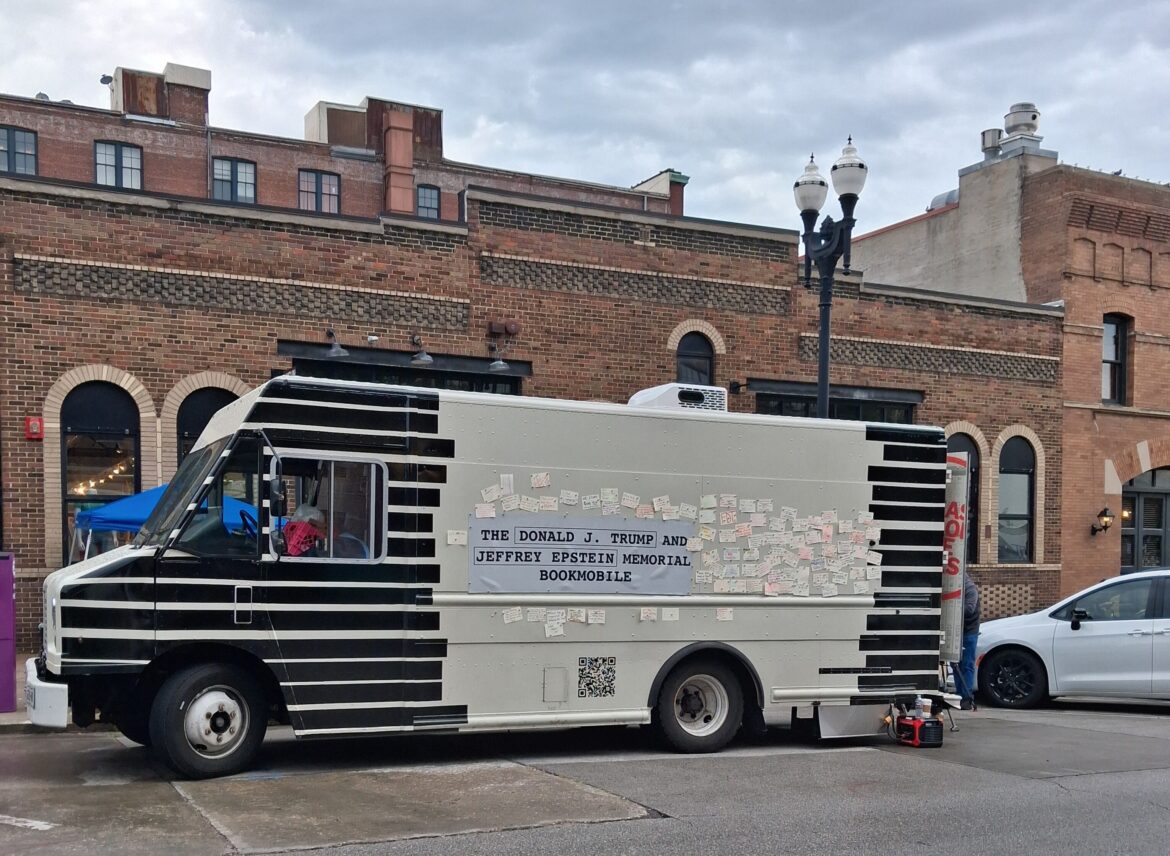
I didn’t go to the Omaha stop of the Donald J. Trump & Jeffrey Epstein Memorial Bookmobile because I thought it would be interesting or entertaining. I certainly didn’t go to make a celebration out of someone else’s trauma. Something like this should never be on anybody’s list of must-see events.
The Donald J. Trump & Jeffrey Epstein Memorial Bookmobile
September 14, 2026
Old Market, Omaha, Nebraska
Words and photos by Adam Tibbott
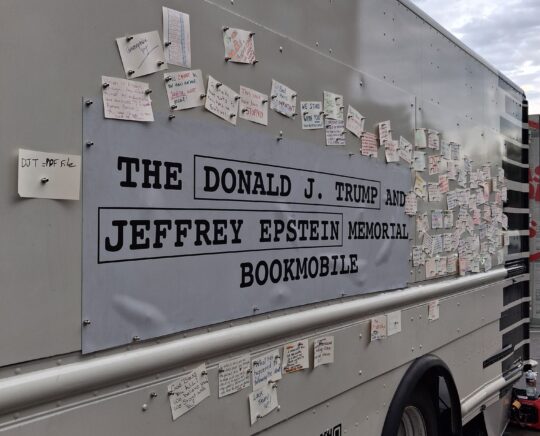
When I first heard that the Bookmobile was coming to Omaha, I didn’t entirely understand what I was going to see. In my head, I pictured something closer to a traveling art installation, a mobile exhibit using documents, photographs and other material to confront people with the enormity of the Epstein story.
I knew the subject matter would be disturbing. What I didn’t know was that survivors would actually be there. I had no idea that before the day was over, I would be standing face-to-face with a survivor of Jeffrey Epstein’s abuse. I had no idea that I would meet members of Virginia Giuffre’s family.
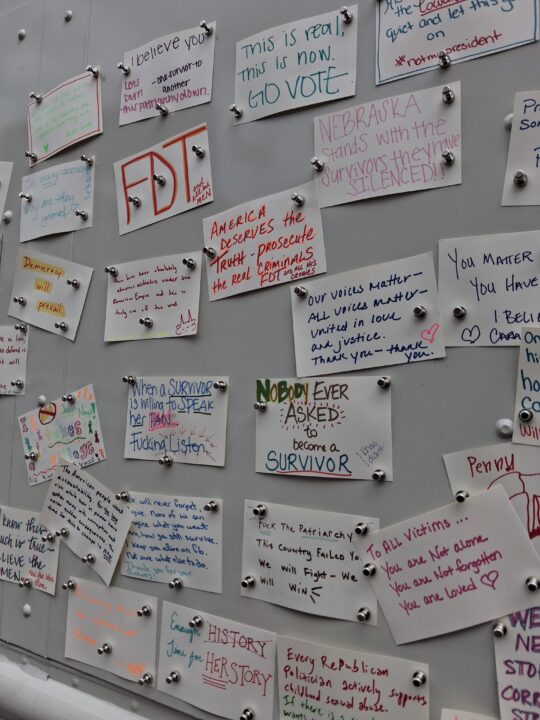
Had I known that beforehand, I don’t know whether I would have approached the day differently. Initially, I went largely out of compassion and support, and because I was taking a friend with me. I didn’t have to go. There was nothing compelling me to spend part of my day surrounded by documents detailing some of the darkest things human beings are capable of doing to one another.
And even now, I’m having a difficult time explaining exactly why I felt like I needed to experience it in person.
I already knew what happened was real. I knew the stories. I knew there were documents. Maybe some part of me needed a reminder. Maybe, uncomfortable as it is to admit, some part of me needed to see the proof with my own eyes. I honestly don’t know. What I do know is that being there affected me far more deeply than I expected.
This wasn’t a political rally for me. Unlike some visitors, I wasn’t there to promote myself as a candidate or political party, and I wasn’t there to turn what happened to these people into another political talking point. There were Nebraska politicians on the November ballot there approaching the event through a political lens, but that wasn’t why I came.
I was there as another human being trying to comprehend something that is almost impossible to comprehend.
Inside the Bookmobile, the sheer scale of the documentation becomes physical. Books line the walls. Volume after volume. Page after page. You can reach out, pull one from a shelf, open it and begin reading.
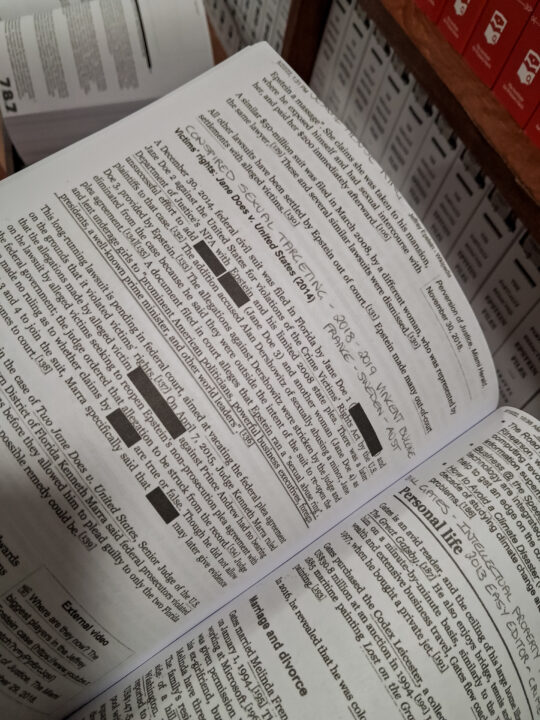
There were so many books surrounding me and so much information contained within them that there was no possible way to process more than a fraction of it during the limited amount of time I had inside the exhibit. I flipped through what I could, reading pieces of documents and looking at the evidence that has been assembled and made available for people to see.
Seeing it physically in front of me was different from reading about it online. A headline disappears when you scroll past it. A news story eventually gets pushed down a website by the next day’s news. Even thousands of pages contained in a digital archive can become something abstract.
It’s much harder to make it abstract when those pages have been printed, bound into books and stacked around you.
But nothing inside those books affected me as much as the people I met outside of them. I had the opportunity to meet Sharlene Rochard, a survivor of Jeffrey Epstein’s abuse, along with Sky and Amanda Roberts, the brother and sister-in-law of the late Virginia Giuffre.
Suddenly, all of those books weren’t simply books anymore. Those pages represent things that happened to actual human beings. They represent lives that were changed, families that continue to live with the consequences and survivors who have spent years asking people to listen.
When I met Sharlene, Sky and Amanda, I didn’t know what to say. All I could tell them was that I was sorry. I know I wasn’t responsible for what happened. I wasn’t part of it. Yet standing there, I still felt something resembling guilt.
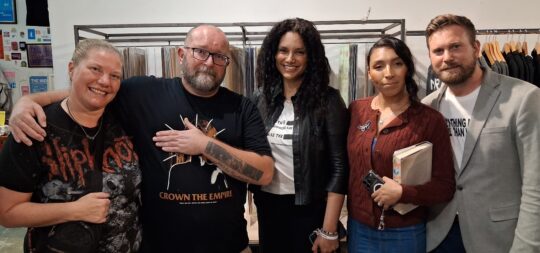
It wasn’t guilt for having caused any of this. It was something much harder to define. I felt guilty that we live in a world where human beings could endure something so horrific and then, after surviving it, still have to fight this hard simply to be heard.
I was sorry that something like the Bookmobile needed to exist in the first place.
I was sorry that survivors and their families have to travel from city to city and put themselves in front of strangers. That they have to tell these stories over and over again. That they have to revisit trauma and grief while knowing that every time they speak publicly, there will be people waiting to scrutinize them, question their motives, pick apart their stories or simply refuse to believe them.
I cannot begin to comprehend the strength and courage that requires. They shouldn’t have to keep proving that their pain is real.
And standing there surrounded by volume after volume of documentation made that reality even more difficult for me to reconcile. In the short amount of time I spent inside the exhibit, I could physically hold some of that documentation in my hands.
Yet survivors and their families are still fighting for transparency and accountability. That may have been the most emotionally difficult part of the entire experience for me.
It’s one thing to read about Jeffrey Epstein, Virginia Giuffre and the survivors from behind a screen. It’s something entirely different to stand inside that vehicle surrounded by those documents and then look into the eyes of people for whom none of this is history, politics or another headline.
It’s their life. And maybe that’s why I needed to go. Maybe I needed, for just a few minutes, to remove the distance that a television screen, phone or news article creates between us and something horrific.
Maybe I needed to stop reading about it and simply stand there and bear witness to it. Or maybe some part of me really did need to see the proof with my own eyes. I’m still not entirely comfortable admitting that, and I still don’t completely understand why I felt compelled to be there.
Maybe I’m not supposed to.
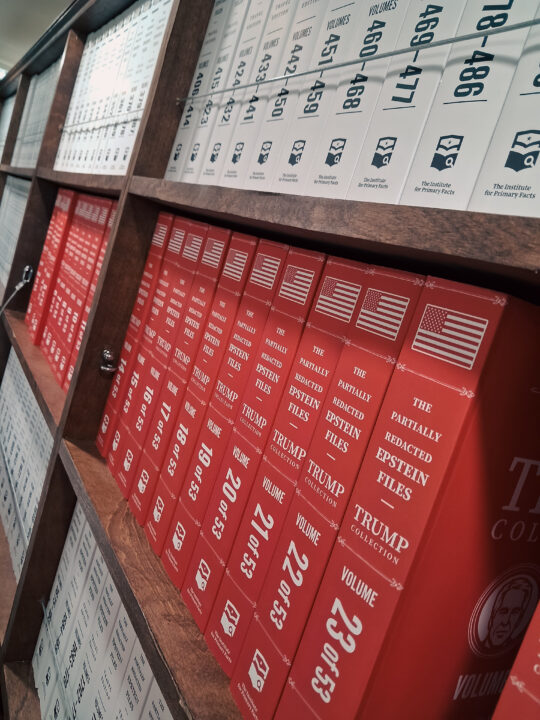
What I do know is that I walked into the Bookmobile knowing what Jeffrey Epstein and the people around him had been accused of doing. I walked in knowing there were victims, survivors, investigations and mountains of documentation.
But knowing something and standing in the physical presence of its consequences are two very different experiences.
I’m grateful I didn’t experience that alone. I had a friend beside me, and after walking through the exhibit and meeting Sharlene, Sky and Amanda, I understood just how much I needed that.
When I walked away, I didn’t feel entertained. I didn’t feel triumphant. I didn’t feel like I had attended a political event.
I felt incredibly sad.
Sad for what happened. Sad for the lives that were damaged. Sad that survivors and their families are still being asked to carry so much of the burden of demanding accountability themselves.
And incredibly grateful that three people who had absolutely no obligation to give any more of themselves were willing to stand there, speak to us and continue telling a story that should never have been theirs to tell in the first place.
Standing in front of them, there wasn’t anything profound I could think to say. There wasn’t a sentence that could somehow acknowledge everything they had endured or make any of it better.
So I said the only thing I could.
I’m sorry.
Follow this LINK for more information, and where you can find the event’s stops. Five Reading Room cities and 20+ Bookmobile stops, September through November 2026. See the full schedule and RSVP.