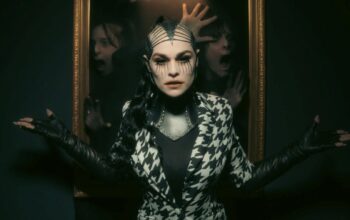
Interview with Morgan Lander — March 31, 2007

By 2007, Kittie had already lived several lifetimes as a band.
Formed in London, Ontario, while its members were still astonishingly young, Kittie exploded onto the metal scene with 1999’s Spit, spent the following years touring relentlessly, appeared on Ozzfest on both sides of the Atlantic, endured lineup changes and label battles, and gradually evolved far beyond the band that had first captured everyone’s attention.
When I spoke with vocalist and guitarist Morgan Lander by phone on March 31, 2007, Kittie had entered yet another chapter.
Their fourth album, Funeral for Yesterday, had been released just weeks earlier through the band’s own label, X of Infamy Records. After years of dealing with the machinery of the music industry, Morgan and her sister, drummer Mercedes Lander, were taking far greater control of their future.
And judging from Morgan’s mood, Kittie wasn’t interested in slowing down.
The band had just finished a tour with Walls of Jericho, and after being away from the road for nearly a year, the response had been better than they could have hoped.
“The tour went great,” Morgan said. “I’d say it was an amazing success. It was the first time we had been out in 10 or 11 months. All the shows were either sold out or packed houses.”
Part of what made the run work, she explained, was its diversity. While every band on the bill existed somewhere within the heavier end of the musical spectrum, no two sounded exactly alike.
“It wasn’t boring,” she said. “We all had the ability to keep the energy up. It wasn’t all the same style. Everybody had their own thing going on. It was all heavy stuff. Good times!”
There wasn’t much time to recover.
Kittie was preparing to head back out beginning April 13 in Toronto, marking their first Canadian show in several years. Walls of Jericho would once again provide main support, joined by In This Moment, Neurosonic and I Killed the Prom Queen.
For a band that had spent much of its existence on the road, touring had become second nature. But when I asked Morgan which tours still stood out after all those years, she didn’t hesitate.
“Ozzfest,” she said. “For crazy memory-wise and that sort of thing, I would definitely say Ozzfest. That was a good mix. Hanging out with bands like Pantera was definitely pretty cool.”
I told her that Ozzfest 2000 was actually when I’d first started listening to Kittie.
“Did you actually see us on the Ozzfest?” she asked.
I told her I had.
“Sorry to hear about that.”
It was an unexpectedly self-deprecating answer from someone discussing the tour that helped introduce her band to an enormous audience.
When I asked why, Morgan laughed off the significance of those early performances.
“A lot has changed,” she explained. “We weren’t the best band back then. We were kind of a different species.”
That willingness to look critically at Kittie’s past became a recurring theme throughout our conversation. Morgan wasn’t dismissing what the band had accomplished as teenagers, but neither was she interested in pretending that the musicians they were at 13, 14 or 16 were the musicians they had become as adults.
Thrown Into Ozzfest
Kittie’s arrival on Ozzfest happened remarkably early in their career.
Morgan remembered a growing buzz surrounding the band at the time, though from her perspective in London, Ontario, the magnitude of what was happening wasn’t immediately obvious.
“We were sort of a late addition to the Ozzfest,” she recalled. “Coming from London, Ontario, I totally honestly didn’t fathom the impact of Ozzfest. It was a crazy time. A lot of fun.”
Kittie would eventually experience Ozzfest both in North America and Europe. Morgan remembered the European festivals as operating on an even larger physical scale.
“The arenas in Europe were bigger,” she said, pointing to Donington Park as an example. “The scale of the festivals over in Europe seemed a lot bigger.”
But Kittie’s rapid rise wasn’t the result of some carefully orchestrated major-label plan. In fact, their earliest attempts to attract industry attention were decidedly less glamorous.
“We sent out quite a few demos in ’99,” Morgan recalled. “We really didn’t get much of a response.”
Eventually, conversations began with NG Records. The band met representatives from the label in Toronto and invited them to see Kittie perform.
“From there, that was history.”
Expectations were initially modest. NG wasn’t a massive label, but Morgan said the people there believed in what Kittie could become.
“They were really, really interested in the band and did see the potential in our music. They wanted to make it happen. It was definitely on a small scale. They just printed a few thousand copies originally, and that was all we were going to sell.”
That prediction proved slightly conservative.
Kittie’s debut album would propel them onto international tours and into the center of the rapidly changing heavy-music landscape of the early 2000s.
Eventually, NG became connected with the newly formed Artemis Records, bringing Kittie along with it.
“It had nothing to do with us being dropped or switching labels or anything like that,” Morgan explained.
The band’s eventual departure from Artemis, however, was considerably less seamless.
“It was a little bit on the negative side, but we are free of them now,” she said. “It took a lot of work, a lot of time, and in the long run a lot of the things that happened kind of hurt the band.”
Still, Kittie survived.
“A fact is a fact, and we came out on the other side relatively unscathed. We are still ready to be a band and make music.”
The experience also left Morgan with advice for younger musicians hoping to follow the same path.
“Definitely educate yourself on the industry,” she stressed. “Find out how contracts work and how the hierarchy of the industry works.”
Never assume that because someone puts a contract in front of you, she warned, that signing it is automatically in your best interest.
“You never really know what you’re going to get into. You never know what you’re signing unless you read it, have a lawyer look at it, and you understand it yourself.”
Becoming Their Own Label
Those experiences ultimately helped lead Kittie to X of Infamy Records, the band’s own label and the home of Funeral for Yesterday.
For Morgan, independence was both exhilarating and exhausting.
“Oh, it’s crazy!” she said. “It’s definitely been a stressful experience, but it’s not really something that is completely new to us.”
Even while signed to their previous label, Morgan said Kittie often found themselves handling work that traditionally would have fallen to the record company.
“Communication was bad. Unfortunately, we had to do a lot of the stuff ourselves to get our name out there and keep going. So now with our new label, it’s just an official title. We’re pretty accustomed to it.”
The difference was ownership.
“It’s really exciting to be your own label, to be the master of your own destiny, help to make your own dream come true. At least you know if you’re going to do the work, it’s going to get done.”
For the moment, however, X of Infamy wasn’t intended to become an empire.
Morgan joked that Kittie would remain the label’s “guinea pigs” before considering signing other artists.
“If our situation works out with Kittie, then we will have the ability to bring in other bands,” she said. “But for right now, we’re just going to focus on ourselves.”
Growing Up With Your Old Songs
Being in a band for more than a decade by age 25 creates an unusual relationship with your own history.
Few musicians have to stand onstage as adults and regularly perform songs they wrote before they were old enough to drive.
For Morgan, one of those songs is “Brackish.”
When I asked whether Kittie still played it live, her answer came immediately.
“Yes, unfortunately.”
She laughed, but there was affection beneath the reluctance.
“We have to acknowledge our past and that sort of thing. It’s just really difficult. It’s a song we wrote when we were 12 and 14.”
The version Kittie played in 2007 had naturally evolved alongside the musicians themselves.
“It’s definitely updated for our ability levels now,” she said. “It’s not a terrible song. People enjoy hearing it.”
That evolution extended throughout Kittie’s music.
The band heard plenty over the years about how dramatically its sound had changed since Spit, but to Morgan, the explanation was simple.
Growing up.
“You can’t really expect to be into the same things you were when you were 12 and 13,” she said. “I’m 25 now. I’ve been in a band for 11 years. There is bound to be some evolution and some improvement.”
Then she summed it up even more succinctly:
“I can’t stay an angry 16-year-old forever.”
Years of touring gave Morgan room to become a stronger guitarist, songwriter and individual.
“Things happened so quickly for us that we didn’t really have time to find ourselves,” she explained. “Only now are we starting to define the art.”
Sisters, Songwriters and “Mouth Guitar”
Music had been part of Morgan and Mercedes’ lives since childhood.
When their family moved to London, Ontario, the sisters were the new kids at school without many friends. Picking up instruments gave them something to do and, without realizing it at the time, helped shape the rest of their lives.
“I think out of boredom,” Morgan said when I asked what originally inspired her to start playing. “We were two kids who just moved there. New kids at the school. We really didn’t have a lot of friends, and I think it kind of shaped and molded our future.”
Growing up, Morgan listened to plenty of ’70s classic rock, including Van Halen and Ted Nugent, but she never viewed herself as someone attempting to duplicate a particular guitarist.
“I just try to do what feels right for me,” she said. “I have more of my own style. I’m more of a rhythm player, and I write songs.”
The flashier work?
“I’ll leave the noodling to Tara.”
At the heart of Kittie’s songwriting remained the relationship between Morgan and Mercedes.
“Usually, it’s just Mercedes and I,” Morgan explained. “We have joint ideas. We talk back and forth.”
And apparently Mercedes possesses a lesser-known instrumental talent.
“Mercedes plays a pretty mean mouth guitar, just so you know.”
Years of writing together had created an almost instinctive communication between the sisters.
“We have such a great relationship, as sisters, as songwriters, that things come together pretty quickly. We kind of know what each other’s next move is going to be.”
Morgan might arrive with riffs for a verse and chorus, while Mercedes had a particular gift for figuring out how the pieces fit together.
“Within 20 minutes to a half an hour, we’ve pretty much mapped out the songs.”
Their roles were becoming increasingly interchangeable as well. On Funeral for Yesterday, Mercedes contributed more lyrics and worked with Morgan on vocal melodies.
Finding the Right Kittie
By 2007, Kittie’s lineup consisted of Morgan, Mercedes, guitarist Tara McLeod and bassist Trish Doan.
Finding that chemistry had taken time.
Tara had been playing locally when Kittie’s management became aware of her. Ironically, she initially contacted management about auditioning for an entirely different band.
“They told her she should try out for Kittie,” Morgan recalled. “She came over, we chatted and clicked, and really that was that.”
Finding the right bassist proved more difficult.
“We tried out a few people and nothing seemed to be clicking.”
Eventually, a mutual friend connected Trish with Mercedes. Trish called, expressed interest in auditioning and came over.
“As soon as she came over, we knew she was going to be the one.”
For Morgan, musicianship was only part of building a successful band.
“Above and beyond ability level, chemistry is what makes a band really click.”
That chemistry extended beyond rehearsals and touring.
“Oh yeah,” Morgan said when I asked if the four actually hung out together when they weren’t working. “It’s something that hasn’t been in this band for a long time.”
Previous incarnations of Kittie had included members living in other cities or even other countries, making it difficult to build friendships away from the stage.
With Tara, Trish, Mercedes and Morgan living near one another, they could practice, hang out and share the same circle of friends.
“Everybody is really settled in,” she said. “Not the weirdness.”
Beyond the Band
Music wasn’t the only creative outlet Morgan and Mercedes were exploring.
Around this time, the sisters launched Poisoned Black, a clothing line born largely from their own frustration with what passed for women’s merchandise.
“It’s kind of our little thing,” Morgan said. “We’re just starting out small.”
The idea had been floating around for years.
“We have pretty distinct, very different styles. I think we wanted to design clothes that we wanted to wear, really.”
Morgan was also fully aware that musician-backed clothing lines were becoming increasingly common.
“I know, ‘Oooh, everyone has a clothing line now,’ but whatever.”
What bothered them was the lack of imagination in many women’s lines.
“Most clothing lines, the women’s line is a wife beater. We wanted to go beyond that. We wanted to design stuff that is pretty cool.”
Not every project supposedly involving Kittie, however, was actually familiar to Kittie.
I brought up reports that the band would appear on an upcoming DVD titled Real Rock Divas, alongside artists including Lacuna Coil, The Donnas, Lita Ford and Bif Naked.
Morgan sounded genuinely puzzled.
“I’m not sure about that,” she said. “I actually haven’t heard about that at all. I read it on Blabbermouth myself.”
So nobody had asked the band for permission?
“That’s what I’m saying. I haven’t heard anything about that.”
Sometimes even the artist learns what’s happening with their career from the internet.
Fans, Glass Eyes and the Importance of Showing Up
One thing Kittie had always made an effort to maintain was a direct relationship with its fans.
I mentioned how much I appreciated seeing the band doing in-store appearances at FYE and continuing to make themselves accessible.
“Absolutely,” Morgan replied. “That is the only reason that we are still here.”
Of course, accessibility can occasionally produce some unusual encounters.
When I asked about the craziest thing a fan had ever done to get their attention, Morgan immediately remembered one.
“There was this one time when this dude pulled out his glass eye and put it into his mouth.”
And then there were the less medically adventurous attempts.
“All kinds of girls lifting their shirts up desperate for attention. Showing us their boobs and stuff.”
Other fans brought gifts or homemade food. Morgan wasn’t about to complain.
“Food or boobs or whatever.”
Not all fan interaction had to involve removable body parts, either.
Kittie had recently performed an acoustic session for Sirius, something that initially pushed the band outside its comfort zone.
“I don’t want to say we were nervous, but it was the first time we had done anything acoustic-wise.”
Only certain Kittie songs translated naturally into that format, but the experience went well enough that Morgan could see the band doing more acoustic performances, perhaps during future in-store appearances.
Marketing Kittie in a Changing World
Running their own label meant thinking not only like musicians, but like marketers.
Still, Morgan didn’t envision Kittie suddenly reinventing how records were promoted.
“I don’t think we’re going to do anything all that different,” she said.
What had changed was technology.
“MySpace and that sort of thing” offered bands new ways to reach listeners directly, but Kittie was still relying heavily on traditional word of mouth, radio, touring and music videos.
The band had recently completed a video that Morgan believed had already received a play on Headbangers Ball.
Choosing singles was partly instinct and partly informal research.
Morgan liked playing songs for friends and trusted listeners, creating what she jokingly described as a kind of focus group.
Another useful measurement was the audience itself.
“Fan reaction at shows,” she said. “And sometimes you just know.”
The Boring Life of a Rock Star
Despite spending so much of her adult life touring, Morgan admitted that she didn’t actually listen to much music while traveling.
She had recently bought an iPod and loaded it with music, including Metallica’s Ride the Lightning and Marilyn Manson, but music wasn’t necessarily how Kittie passed the hours.
“We have each other,” she said. “We actually really like each other in the band.”
There was plenty of conversation, watching the other bands perform, interviews and, naturally, sleeping in.
“The life of a rock star,” Morgan deadpanned. “It’s boring.”
I wasn’t entirely convinced.
“It can get exciting,” she conceded.
After years of headlining, Kittie hadn’t served as a traditional support act for roughly seven years. But if the right opportunity came along, Morgan wasn’t opposed to it.
“I would love to do a tour with Iron Maiden, Metallica,” she said, adding that large summer festivals such as Warped Tour and Family Values also appealed to her.
Don’t Call Them a “Female Band”
Perhaps inevitably, our conversation eventually turned toward one subject that had followed Kittie throughout its career: categorization.
Metal bands get labeled obsessively—nu-metal, alternative metal, death metal, thrash, metalcore—but Kittie had another label attached to them from the beginning.
“Female band.”
Morgan had little patience for it.
“We’re a heavy band. Metal. We have a lot more other elements,” she said. “We’re not a female band. To me, that’s not a fucking category.”
Labels could help audiences understand a band, but they could just as easily prevent someone from ever listening.
“Music is music,” Morgan continued. “It transcends all age, all genre classifications, all boundaries, labels. That’s just the way it should be.”
If she absolutely had to describe Kittie’s music to someone who had never heard them, however, she could live with one description.
A melodic metal band.
“We have a lot of different elements,” she explained. “Some of our stuff is even a little thrashy. If you listen to our new album, it has a lot of melody.”
Then Morgan offered what may have been the simplest description of where Kittie stood in 2007:
“A nice contrast of dark and light. Heavy and beautiful.”
That description fit more than Funeral for Yesterday. It described a band caught between its history and its future.
Kittie had begun when its members were children. By the time of our conversation, Morgan Lander had already spent nearly half her life inside the band. She had experienced early success, massive festivals, label politics, lineup changes, criticism, touring and an evolution that had played out publicly while she and her sister were still figuring out who they were.
Now, for perhaps the first time, Kittie had something they hadn’t possessed during those whirlwind early years: control.
They had their own label. They had a lineup that actually enjoyed spending time together. They had a new album they believed represented who they had become. And after nearly a year away from touring, they had returned to packed rooms.
Before we ended the call, I thanked Morgan for taking the time to talk.
“No problem. Thank you,” she replied. “Hopefully we’ll get to see you when we come through your area.”
Sixteen-year-old Morgan Lander couldn’t stay angry forever. But Kittie wasn’t going anywhere.